Guelphs
The Guelphs were one of the two principal political factions in medieval Italy, defined by their allegiance to the Papacy in opposition to the Ghibellines, who supported the Holy Roman Emperor. In Dante Alighieri's Divine Comedy, the Guelph-Ghibelline conflict is not merely a historical backdrop but a central moral and political concern, representing the discord that Dante believed had corrupted Florence and the wider world. The poem consistently condemns the factionalism that set citizen against citizen, and it presents the Guelphs' entanglement with the Church as a perversion of both spiritual and temporal authority.
Political and Theological Context
Dante's critique of the Guelphs is inseparable from his broader political theology, which advocates for a clear separation of spiritual and temporal powers. In Purgatorio, the poet Marco Lombardo laments that Rome, which once had "two suns" to illuminate the paths of God and the world, now has one light quenched: the sword has been joined to the crozier, and the two powers, being joined, "ill beseemeth it / That by main force one with the other go" (E07211–E07216). This imagery directly implicates the Guelph faction, which championed papal authority over imperial authority, thereby confounding the two governments. Dante argues that this confusion causes the Church to "fall in the mire, and soil itself and burden" (E07232–E07234). The Guelphs, by aligning themselves with the Papacy in its temporal ambitions, are thus seen as agents of this disastrous conflation.
The Guelphs in Dante's Prophecy and Judgment
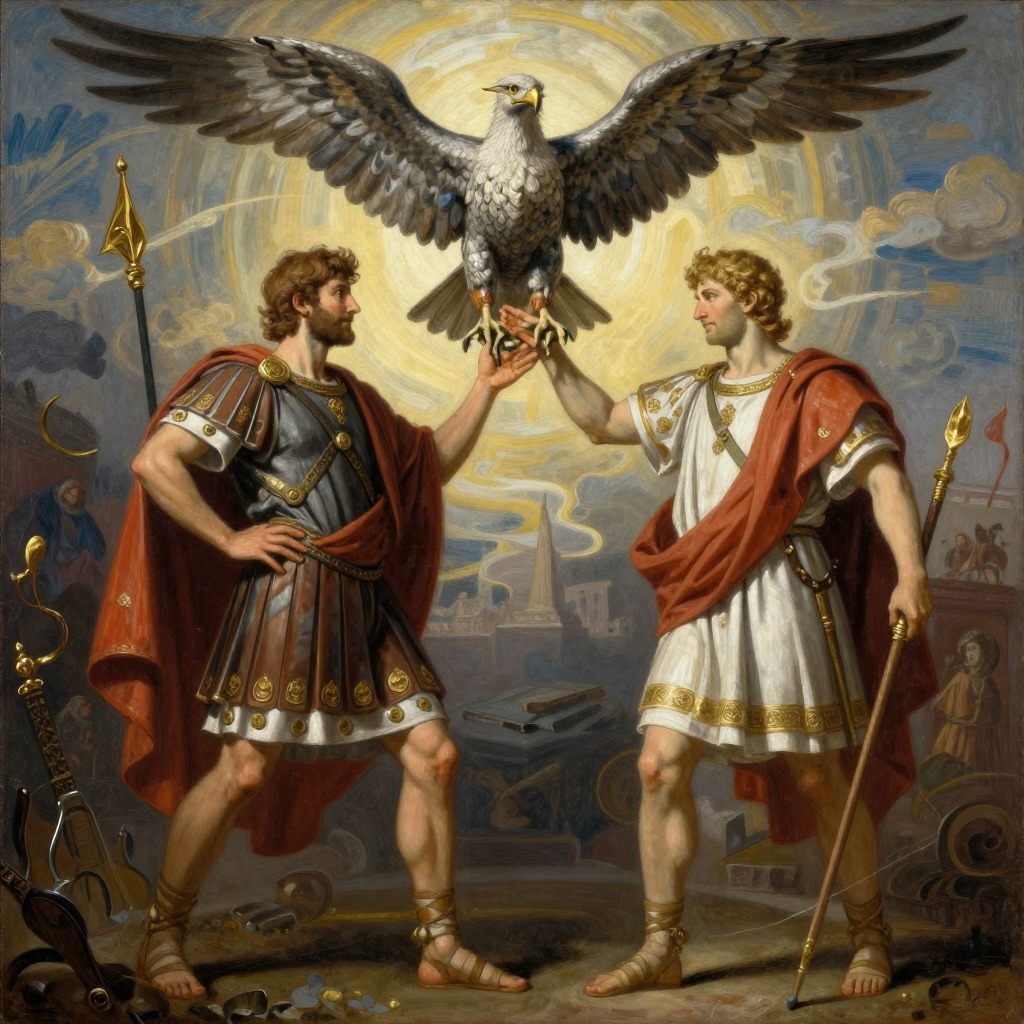
Dante's condemnation of the Guelphs is most explicit in the Heaven of Jupiter, where the Eagle of Justice pronounces judgment on corrupt rulers. The Eagle declares that the standard of the Roman Empire should not be opposed by those who "the yellow lilies" (the fleur-de-lis of the French monarchy, a key Guelph ally) set against it, nor by those who claim it for a party (E10566–E10568). This directly rebukes both the Guelphs and the Ghibellines for their partisan misuse of the imperial symbol. The Eagle further warns that the Guelph leader Charles of Valois, who invaded Italy at the Pope's behest, should fear the talons of the imperial eagle, for "already oftentimes the sons have wept / The father's crime" (E10575–E10576). The poem thus presents the Guelph alliance with the Papacy and the French crown as a betrayal of the divinely ordained Roman Empire, a sin that will bring divine retribution.
The Guelphs and the Corruption of Florence
Dante's personal experience as a Florentine exile deeply colors his portrayal of the Guelphs. In Paradiso, his ancestor Cacciaguida prophesies Dante's banishment from Florence, a city torn apart by factional strife. The prophecy states that Dante will be forced to leave everything he loves most tenderly, and that he will experience "how savoureth of salt / The bread of others, and how hard a road / The going down and up another's stairs" (E12127–E12132). This exile was a direct result of the victory of the Black Guelphs, who, with the support of Pope Boniface VIII and Charles of Valois, seized power in Florence and banished their opponents, including Dante, who was a White Guelph. The poem thus frames the Guelph faction, in its pursuit of power, as the instrument of Dante's personal tragedy and the ruin of his beloved city.
The Guelphs and the Church's Degeneration
Dante's critique extends to the Papacy itself, which the Guelphs served. In Paradiso, St. Peter denounces the corruption of the Church, declaring that his place on earth has been usurped, and that his cemetery has been made "a sewer / Of blood and stench" (E13548–E13552). This corruption is directly linked to the political machinations of the Papacy, which the Guelphs supported. The poem's vision of a reformed world, symbolized by the coming of a "Five-hundred, Ten, and Five" (a cryptic prophecy of a deliverer), promises the destruction of the "thievish woman" (the corrupt Church) and the "giant" (the French monarchy) who sins with her (E09656–E09658). This prophecy implicitly condemns the Guelph alliance that had brought about this state of affairs. The Guelphs, in Dante's view, were not merely a political faction but a symptom of a deeper spiritual sickness, a betrayal of the true mission of both the Church and the Empire.